Tier classification quick facts
Developed by:
Uptime Institute
Tiers:
I through IV, based on redundancy and fault tolerance
Highest tier:
Tier IV - fully fault-tolerant
Role of commissioning:
Verifying the tier's required redundancy and fault tolerance actually work
Why uptime is the metric that matters
For a data center, uptime is everything. One of the most widely used ways to measure and certify it is the Tier Classification system developed by the Uptime Institute - a framework for assessing a facility's design and operational resilience based on redundancy level.
For more on the testing levels involved, see our article on data center level testing.
Understanding the Tier Classification system
The system sorts data centers into four tiers, Tier I through Tier IV, based on infrastructure design, availability, and fault tolerance. Each tier up represents a meaningful jump in resilience and redundancy, with Tier IV as the most robust.
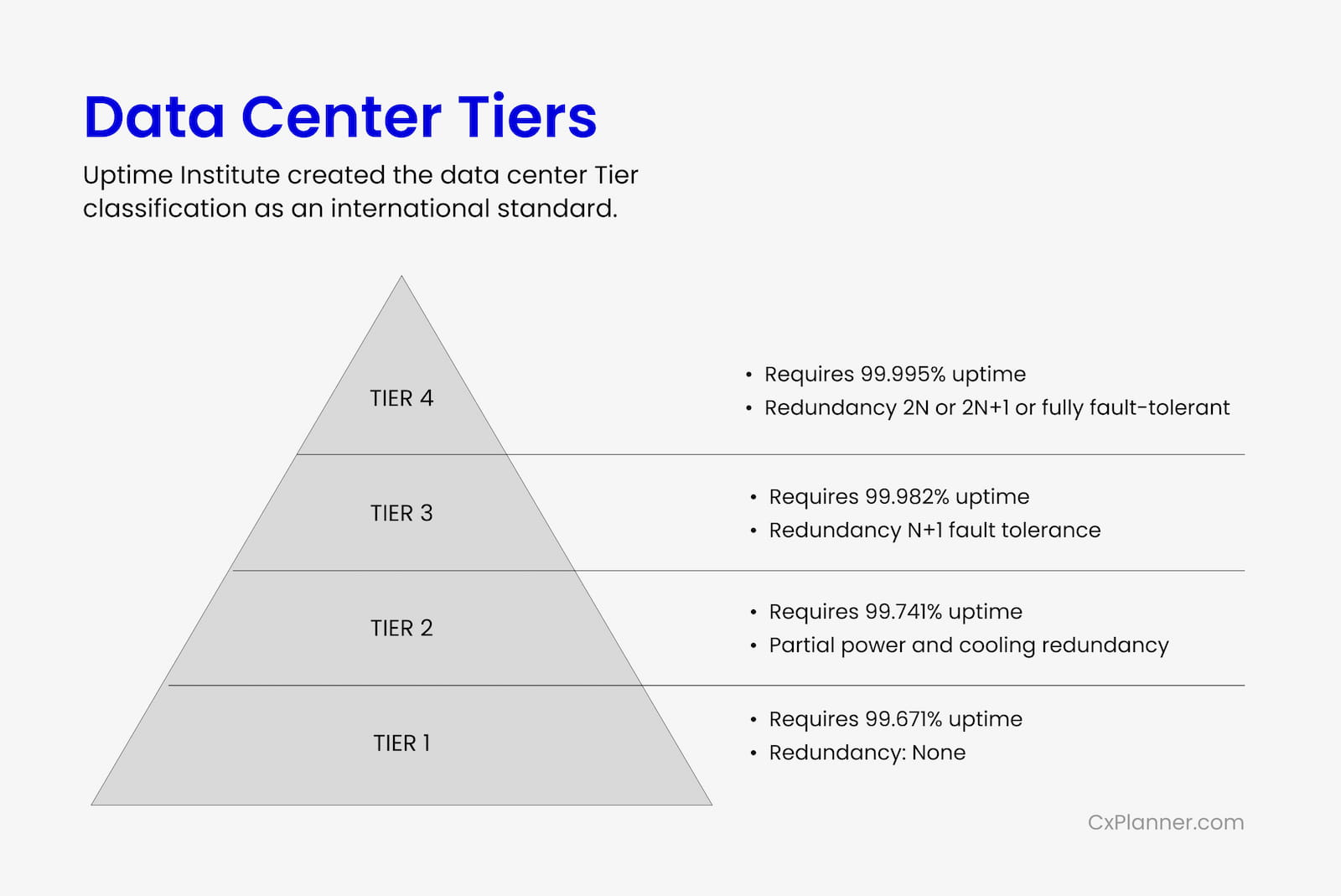
Commissioning requirements by tier
Commissioning is how a data center proves it actually meets its target tier. The requirements scale with the tier:
- Tier I: Basic infrastructure with limited redundancy. Commissioning focuses on verifying basic functionality and confirming minimum uptime requirements are met.
- Tier II: Some redundancy built into critical systems. Commissioning tests redundant components, assesses fault tolerance, and validates failover mechanisms to reduce downtime risk.
- Tier III: Concurrently maintainable infrastructure, so maintenance and upgrades don't require downtime. Commissioning validates redundant paths, fault tolerance, and concurrent maintainability.
- Tier IV: Fault-tolerant architecture with multiple independent systems, built to withstand severe disruptions. Commissioning rigorously tests redundant components, fault isolation, and fault tolerance to confirm continuous operation under any condition.
Practical testing examples by tier
Tier I: Basic capacity and redundancy
- Power capacity testing - load testing power distribution to identify limitations or bottlenecks
- Cooling capacity testing - checking HVAC performance under full load to prevent overheating
- Redundancy verification - confirming generators and UPS systems maintain operations during an outage
Tier II: Redundant capacity components
- Redundant path testing - validating seamless failover across power and cooling paths
- Concurrent maintainability testing - simulating maintenance to confirm no downtime results
- Fault tolerance testing - verifying automatic transfer switches and failover mechanisms work without interruption
Tier III: Concurrently maintainable
- Concurrent maintenance simulation - live-testing maintenance on redundant components while the facility stays operational
- Fault isolation testing - simulating failures to confirm faults stay contained without affecting overall operations
- Redundant component load balancing - checking load distribution to avoid overloading if a component fails
Tier IV: Fault tolerant
- Full load redundancy testing - validating redundant components under peak demand
- Simulated disaster scenarios - testing response to power grid failures or equipment malfunctions
- Zero downtime maintenance - demonstrating maintenance on critical systems with no operational impact
Matching commissioning activities to each tier's specific requirements is how operators validate their facility's resilience and stay compliant with the standard.
Managing tier compliance with CxPlanner
CxPlanner is built to support the commissioning process on data centers, with structured workflows for every testing level, documentation generation, and Tier Classification compliance. Key capabilities include:
- Centralized management - one platform covering planning, scheduling, execution, and documentation, so stakeholders track progress in one place
- Structured templates by tier - predefined tests, procedures, and documentation requirements mapped to each tier
- Level-based testing management - defining test plans and tracking completion across Level 1 through Level 5
- Automated documentation handover - generating test reports, compliance certificates, and equipment records ready for stakeholders and regulators
- Real-time reporting - tracking milestones, compliance status, and risk areas as they happen
Want to see how CxPlanner manages tier-specific test plans and documentation on your own data center project? Book a demo and we'll walk you through it.
Book a demo with Thomas