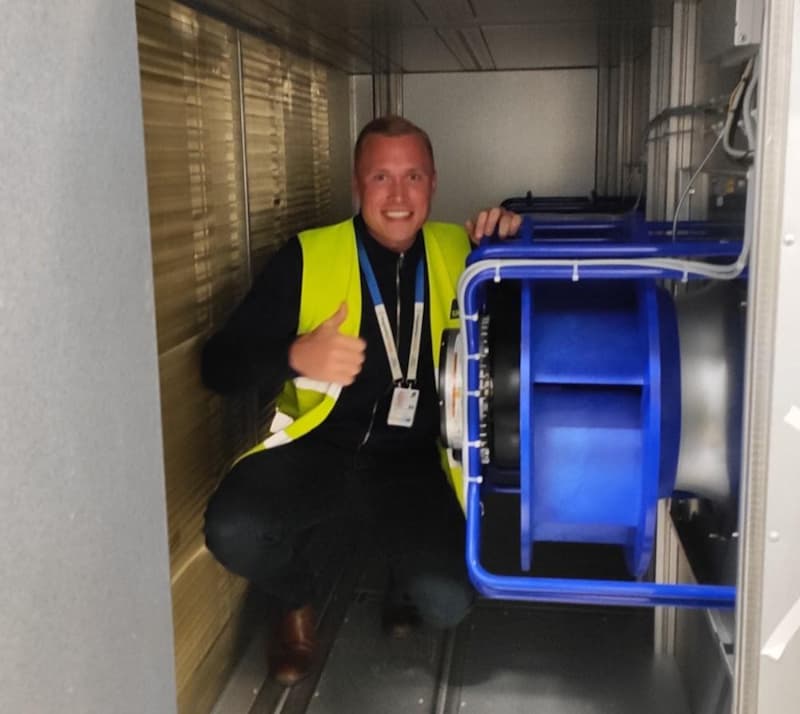
By Thomas Toftgaard Jarloev, Founder & CEO of CxPlanner
I didn't trust AI either.
I'm a commissioning guy. Fifteen years in the field. Switchboards, thermal cameras, turnover packages, the lot. I've written books on commissioning. I hold QCxP, CxM, CxA - the first in the EU to hold both CxM and CxAP. The last thing I wanted was a piece of software pretending it could replace the judgment I'd spent a career building.
And honestly, the noise didn't help.
LinkedIn is full of people selling AI as magic. "AI-native consultants" pushing black boxes and hot air. Tools that promise to do your job for you, written by people who've never been on a job site. It made me skeptical. It should make you skeptical too. I didn't want to be one of those people. I didn't want commissioning to become that kind of industry.
But I built CxAI anyway. Here's why.
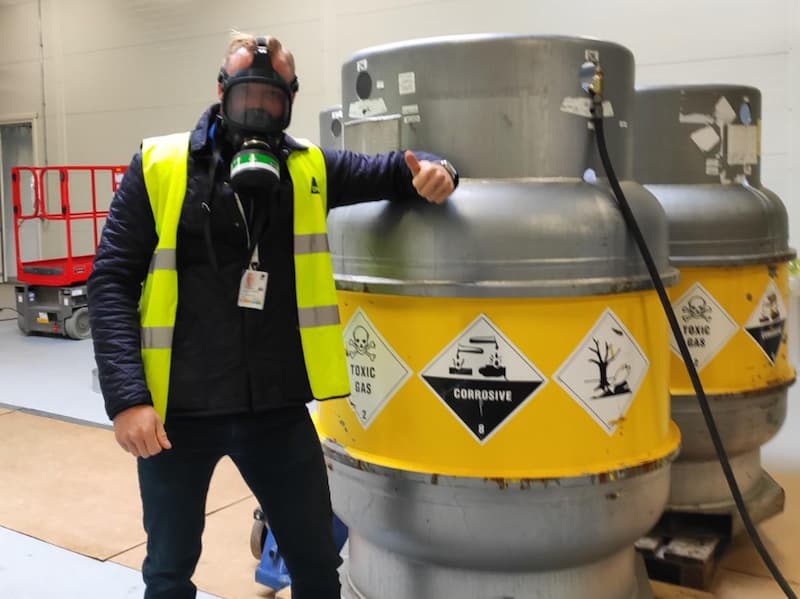
2022: Before we called it anything
CxPlanner shipped our first AI-powered feature in 2022. It was a template generator for checklists, trained on thousands of internal patterns. You'd pick an asset type, a category, a focus area, and the system would draft a checklist for you. The expert ran through it at the end. The repetitive part was gone.
It saved real time, even back then.
But I'll be honest - we were careful with the word "AI." The market wasn't ready. Frankly, neither were we. We talked about it internally as an AI-powered template generator, but we didn't push the AI angle in our marketing. We didn't put it on the homepage. We didn't write thought-leadership posts about it.
We just shipped it, and it worked.
That feature is still in CxPlanner today. It's grown into something far more capable. But the philosophy was already in place: build useful things, let the technology do the boring part, and leave the judgment where it belongs.
The thermal camera
I'll tell you when AI clicked for me.
I was teaching a masterclass in commissioning and talking about my early days as an electrician building industrial switchboards. After mounting and termination, we'd run a 24-hour load test. Then I'd walk through with a thermal camera. Faulty components, bad terminations - they show up as heat. You see them on the screen before they become a problem.
Then I thought about my mentor. A few years before that, he didn't have a thermal camera. He had to touch the components with his hands and make a judgment call about whether something was running hot.
Same job. Same expertise. Different tool.
That was the moment.
Why wouldn't you use a tool that saves time and improves the output? My mentor wasn't a worse electrician than me. He just had fewer instruments. The thermal camera didn't replace his judgment. It extended it.
That's what AI is, in commissioning. Not a replacement for the expert. An instrument the expert uses. AI is the tool. You're the operator.
Once I saw it that way, the skepticism turned into something more useful: a clear set of rules about where AI belongs and where it doesn't.
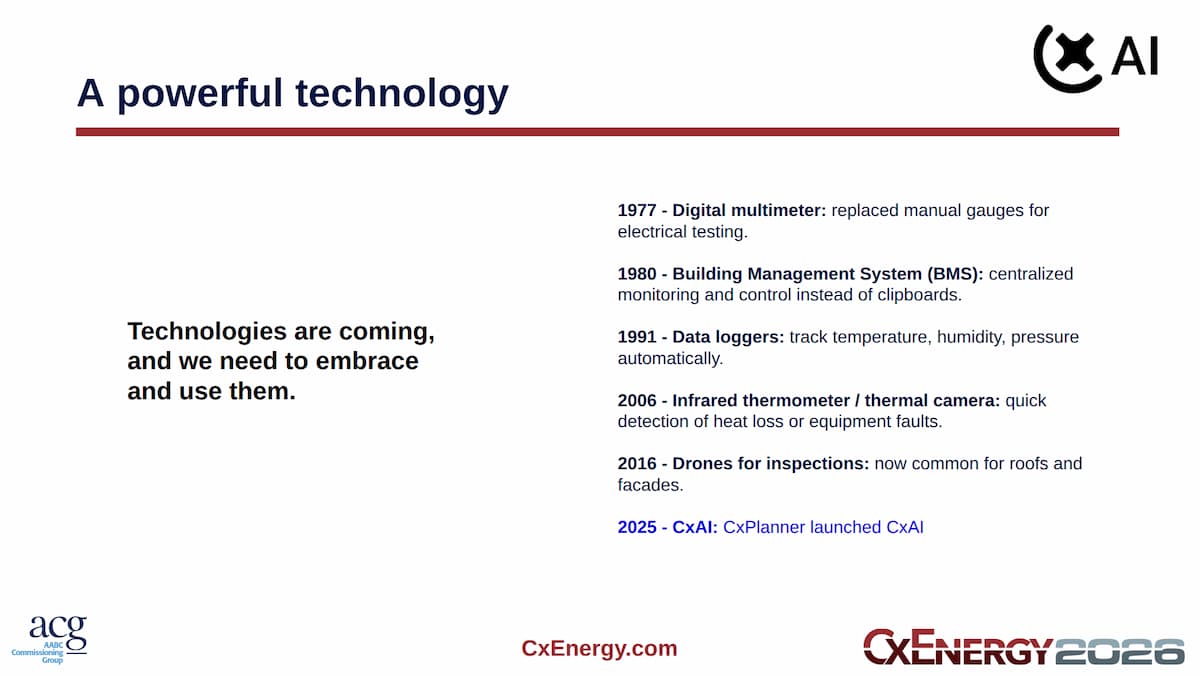
January 2025: A name for the work
January 2025. A strategy session at our office and a few hours with part of the team, working through what we'd build next.
We weren't trying to invent a category. We were trying to decide which AI features were worth building and which were just noise. The phrase we kept coming back to - the test we used on every idea on the whiteboard - was simple.
Less admin. More commissioning.
If a feature removed admin, it stayed. If it just added more software for the sake of more software, it went. That phrase wasn't polished marketing copy. It was the question we used to filter the work.
The name came out of the same session. Cx for commissioning. Cx for CxPlanner. AI. CxAI.
It felt right immediately. We used it internally that day. We used it publicly the same month.
We didn't announce it as a category. We just started using it because we needed a word for what we were already building.
Name and logo:
On the stage
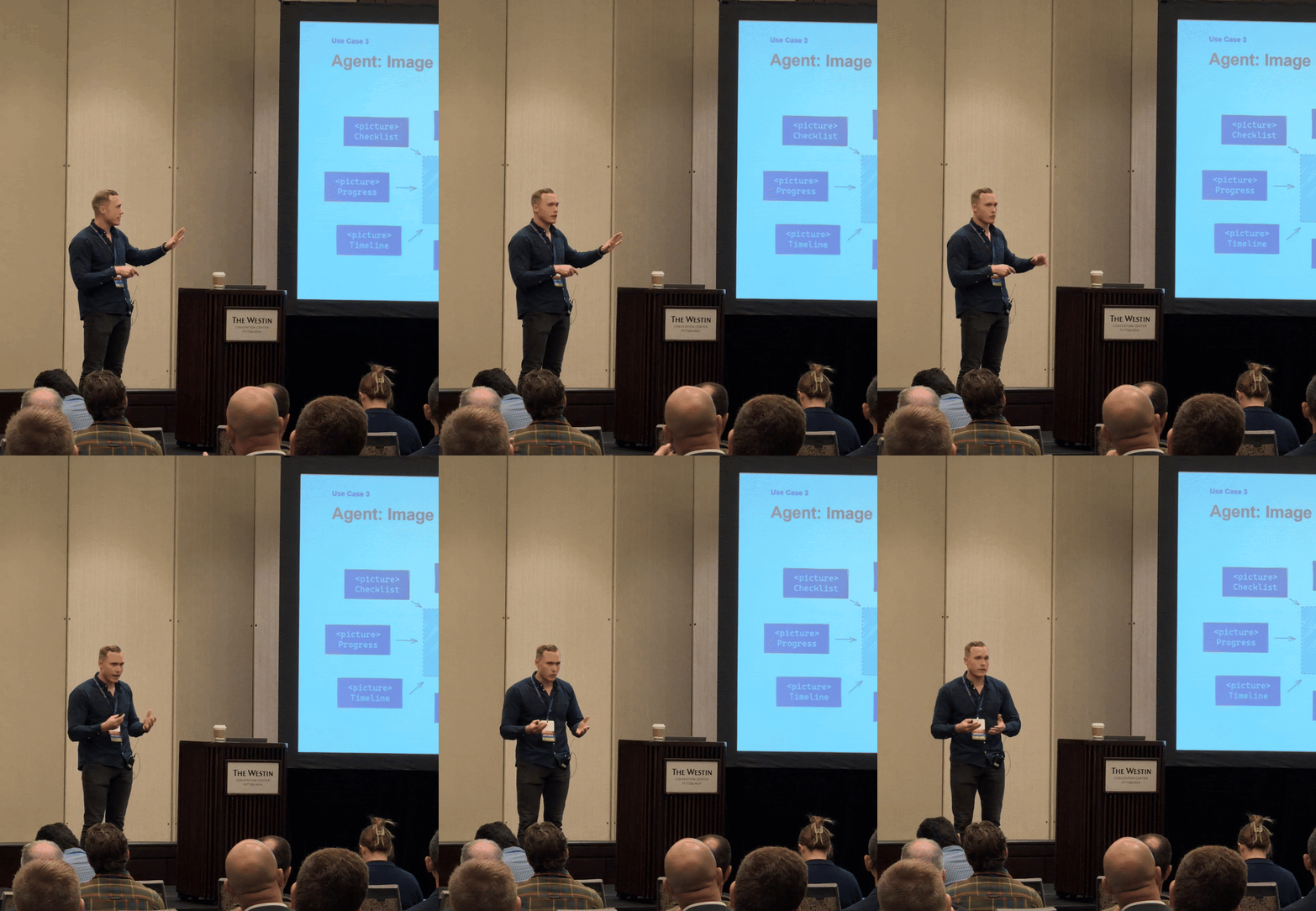
In October 2025, I presented three mindsets at the BCxA Annual Conference - the framework I'd worked out by then for thinking about AI in commissioning:
- AI is the tool, not the operator.
- AI can make you smarter - not take over your job.
- AI should be used in the right places, not everywhere.
Six months later, in April 2026, I was back on stage as a keynote speaker at CxEnergy in Chicago. Same framework. Same conviction. Another year of building behind it.
I wasn't on either stage as a software CEO pitching a product. I was there as a commissioning professional who'd worked through the skepticism and come out with a practical framework. That's the difference between a vendor and a practitioner.
Those three mindsets are still the foundation CxAI is built on. They're not marketing copy. They're how we decide what to build - and what not to build.
What CxAI actually is
CxAI is not a chatbot bolted onto the side of CxPlanner. It's not a separate place to work, a separate window to open, a separate license to pay for. It's built into the commissioning workflow itself - documents, checklists, asset data, field work, reporting.
Here's a real example.
A test fails on site. In the old workflow, you open five PDFs, search for the right section in the spec, dig through the manual, copy-paste the relevant part into a report, and email three subcontractors before lunch.
With CxAI: the test fails. CxAI reads the spec. Reads the manual. Finds the relevant section. Suggests what to check. The commissioning professional makes the call. The work moves forward.
That's the difference.
Same for asset registration. You're on site. Wind, noise, twenty assets in front of you. Cold fingers. Instead of typing serial numbers by hand, you take a photo of the nameplate. CxAI extracts the data - serial numbers, specifications, asset details - and structures it. Done.
This is the difference between AI as a marketing layer and AI built into the workflow. One looks impressive in a pitch deck. The other gets the project moving.
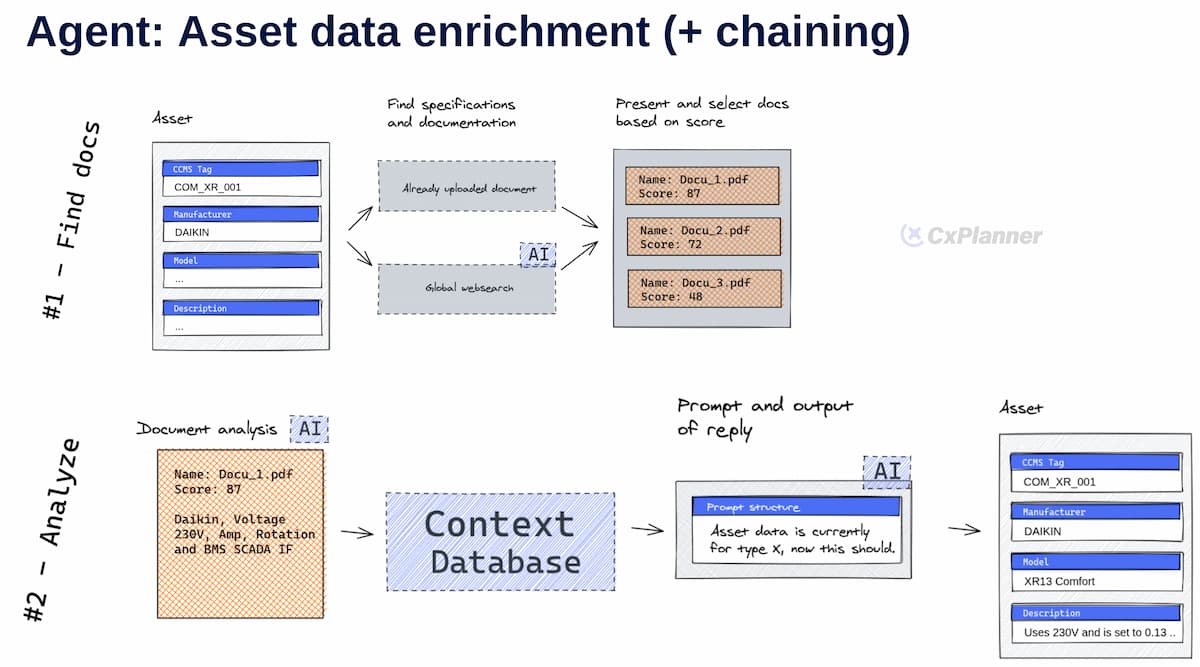
The flowchart below shows an actual agent - pulling data from specs and auto-inserting it into assets.
The category is forming
The market has started moving in the direction we were already building. More companies are talking about AI in commissioning. More tools are launching. The vocabulary is spreading.
Recently, others have started using the same word.
That's how categories form. The work behind the word is what matters now.
This is good for the industry. Commissioning teams deserve better software, and a category with more serious entrants is a category that moves faster. We welcome the movement.
Speed and AI are the same belief
CxPlanner is the fastest commissioning platform ever built. CxAI is part of that.
Speed isn't a feature. It's the same belief expressed two ways - that commissioning teams should be free to do commissioning. A fast platform removes friction. CxAI removes admin. Both serve the same goal: letting skilled people do skilled work, without the software getting in the way.
In many projects, 60 to 70 percent of the time goes into admin, not commissioning. That's the problem we're working on. Every part of CxPlanner - speed, design, workflow, CxAI - exists to bring that number down.
The work in 2022 started without a name. The name came in January 2025. The framework came together on the BCxA stage in October, and again at CxEnergy in Chicago. The category is forming now.
We're early. We're proud of where we started.
And we're more interested in what comes next.
CxAI started here. And the work continues.
Thomas Toftgaard Jarloev is the Founder & CEO of CxPlanner. QCxP, CxA, CxM. 15+ years in commissioning. First in the EU to hold both CxM and CxAP. Author of commissioning books and guidelines.