Vancouver enforces mandatory commissioning for large new buildings
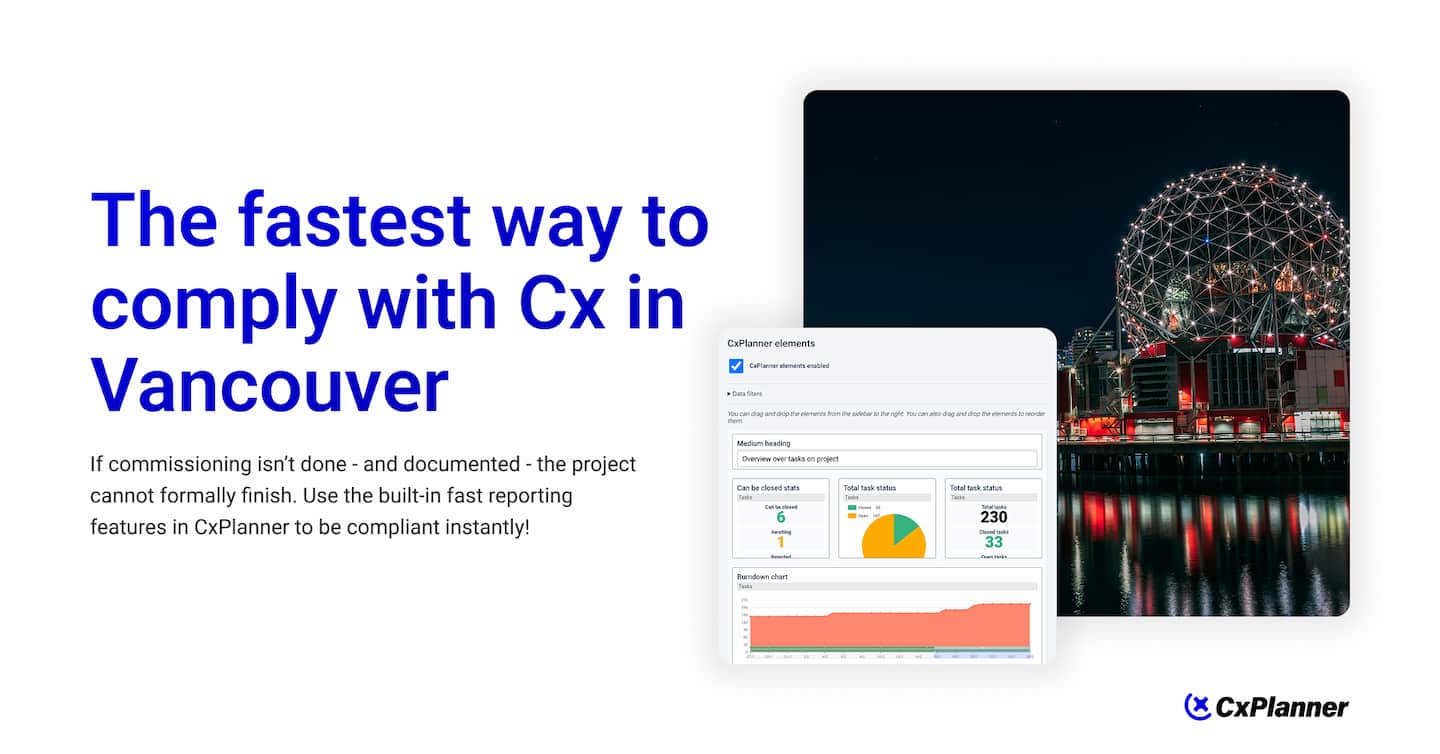
Vancouver has made commissioning a non-negotiable part of delivering large buildings. With the 2025 Vancouver Building By-law (VBBL), commissioning of energy-using systems becomes a formal code requirement rather than just a policy expectation. 👷
For Cx professionals, that means commissioning moves even closer to the critical path of getting a building permitted, occupied, and finally closed out.
- Scope and timing of the New Commissioning Requirement
- Commissioning as a condition for occupancy and completion
- Lower Emissions - Higher Stakes for Commissioning professionals
- What is the new Cx code requirement based on?
- What this means for your commissioning practice
Scope and timing of the New Commissioning Requirement
On September 15, 2025, the new VBBL came into effect. From that date, all new Part 3 buildings (larger and more complex buildings such as offices, multi-unit residential, and institutional buildings) in Vancouver have to include commissioning of energy-using systems under the Energy Efficiency section.
Up until September, commissioning has only been mandatory for Part 3 projects that received rezoning approval under the city’s Green Buildings Policy (since 2017) - roughly half of all new Part 3 construction. The 2025 VBBL closed that gap and extended commissioning requirements to all new Part 3 projects, plus certain work in existing buildings.
In practice, every larger or more complex building will need a defined Cx scope for energy-using systems, a commissioning plan, and formal reporting at key milestones, making structured digital commissioning tools increasingly important.
Commissioning as a condition for occupancy and completion
The new by-law doesn’t just say “do commissioning” - it ties commissioning deliverables directly to approvals.
In practice, commissioning is required at two key milestones:
- Before building permit a draft commissioning plan must be prepared and submitted.
- Before occupancy - a commissioning report, based on the accepted plan, must be provided or occupancy can be withheld.
So the message is clear: if commissioning isn’t done - and documented - the project cannot formally finish.
Lower Emissions - Higher Stakes for Commissioning professionals
The new code is an important step toward better-performing, lower-carbon buildings. But it also increases the pressure on commissioning teams.
Cx professionals now sit firmly on the critical path at multiple points in the project. A preliminary commissioning report is required before occupancy, and a final report is required at the end of the warranty period. If those deliverables aren’t ready, the project can’t move on.
That raises the bar for process discipline. Cx plans, test forms, issues logs, and reports need to be structured, traceable, and kept current from design through construction and early operation.
For many teams, this new reality will be hard to manage with manual admin alone, and there is growing value in digital commissioning tools - including AI-supported assistants that can take over repetitive documentation and coordination work.
What is the new Cx code requirement based on?
The VBBL does not invent a brand-new commissioning process. Instead, it anchors the requirement in familiar industry guidance:
- ASHRAE Guideline 0 - the core framework for the commissioning process
- ASHRAE Standard 202 - a more recent, formal standard based on Guideline 0, defining commissioning as a professional practice for building systems
Vancouver is the first jurisdiction in Canada to explicitly adopt Standard 202 into its building by-law.
For Cx professionals already working with ASHRAE-aligned processes, this provides alignment: owner's project requirements, basis of design, Cx plan, pre-functional and functional testing, issues resolution, and structured reporting are all part of the expected workflow.
What this means for your commissioning practice
For Cx professionals, Vancouver’s new framework formalizes what many have argued for years: commissioning has to be baked into the project from the start, not bolted on at the end. It brings more structure, but also more accountability and more documentation.
This is a good moment to review your own workflows: how you develop Cx plans, track issues, align with ASHRAE Guideline 0 and Standard 202, and produce preliminary and final reports that can stand up to code review.
CxPlanner's platform is built around exactly these commissioning workflows - from structured test libraries and ASHRAE-aligned processes to centralized documentation for complex projects.
Book a demo and explore how a digital commissioning platform can support compliance with the 2025 VBBL.