What is level testing in data center commissioning?
Data center commissioning verifies that every system in the facility - power distribution, cooling, backup generation, IT infrastructure - is designed, installed, tested and operating the way it was intended to.
Rather than describing the process the way ASHRAE Guideline 0 does for general construction, data center projects organise testing into numbered levels. Instead of talking about an OPR and a BOD, the data center industry talks about Levels.
The goal is the same as any commissioning programme: catch problems as early in the build as possible, when they're still cheap to fix.
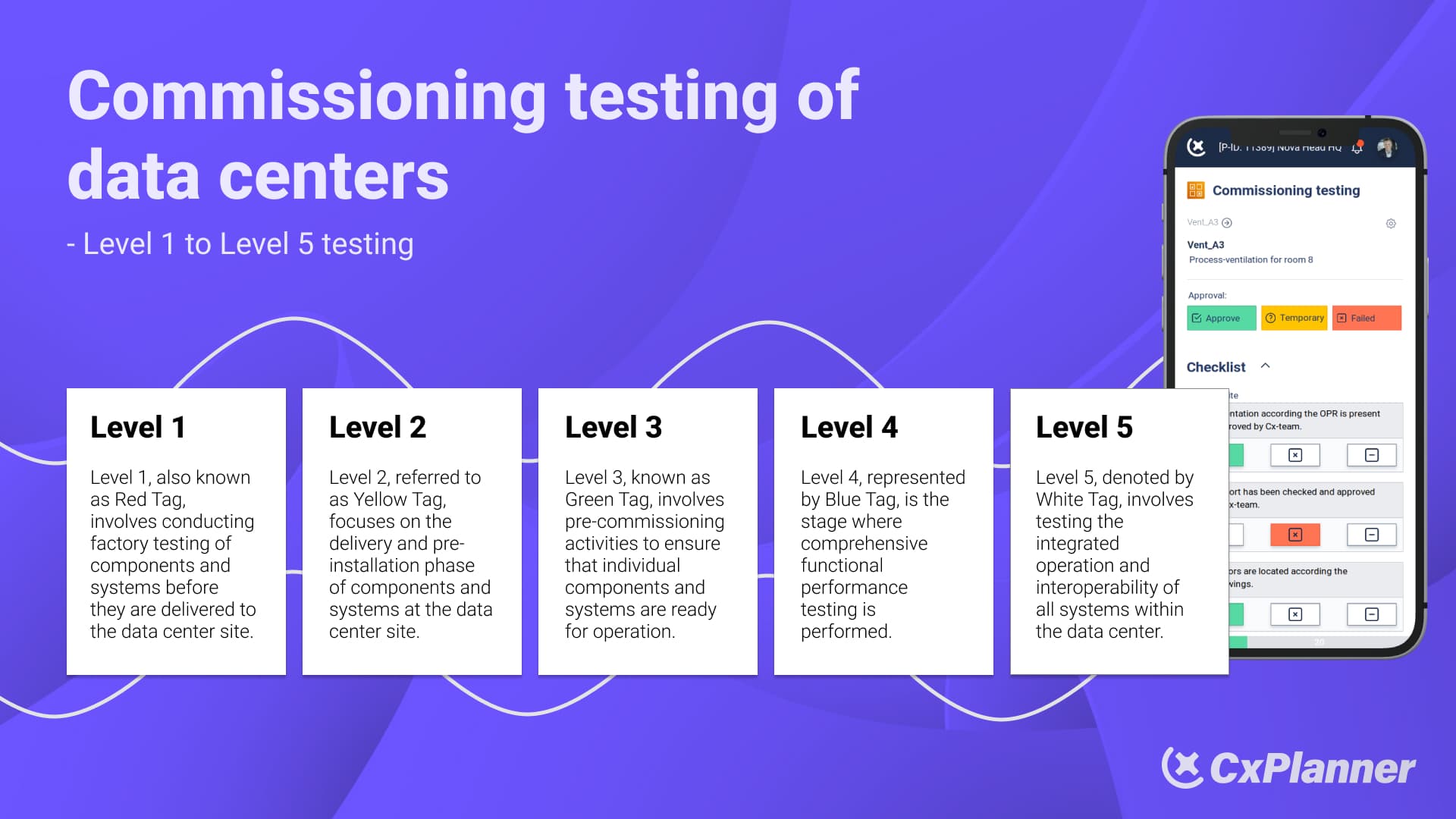
The five levels of commissioning testing
Each level covers a different stage of the build, and the scope widens as the project moves from individual parts to the finished, integrated facility.
Level 1 - Red Tag (factory testing)
Equipment is tested at the factory before it ever reaches site. Servers, cooling units and power distribution gear are put through controlled testing to confirm they perform the way the spec says they should, before they're shipped.
Level 2 - Yellow Tag (pre-installation)
Once equipment arrives on site, it's inspected against the original specification and prepared for installation - the check that happens before anything gets bolted down.
Level 3 - Green Tag (pre-commissioning)
Individual components get their first functional checks and initial startup on site, confirming they're ready to be tied into the wider system.
Level 4 - Blue Tag (functional performance testing)
Each component and system is tested against its performance criteria in full - this is where functional performance testing happens component by component.
Level 5 - White Tag (system integrated testing)
Every system is tested together, not in isolation, also known as Integrated System Testing. A typical Level 5 test simulates a full power failure - a blackout test - to confirm the UPS units carry the load and the generators start exactly as designed.
Structuring the levels across a project
Most data center projects run all five levels, though some teams extend the model further - down to Level 0 or up past Level 7 - simply to add more checkpoints along the way. A Level 7, for instance, might just be a check-in during the first year of live operation to confirm everything is still performing as intended.
What matters more than the exact count is the principle: verification scope grows with each level, from a single component at Level 1 to the entire integrated facility at Level 5.
Our companion article walks through how this looks on a real data center project, including a worked example.
Do data centers actually need commissioning?
Technically, any data center can go live without a formal commissioning programme. The real question is how long it stays reliable, and what it costs to keep it running once problems surface after handover rather than before it.
The five-level structure exists because the one failure mode a data center can't absorb is downtime. Structured level testing is what catches the issues that would otherwise only show up once the facility is live.
Why not just follow ASHRAE's process instead of the 5 levels?
ASHRAE Guideline 0 is a solid foundation, but it was written for general construction, not the specific mix of IT load, cooling and backup power that defines a data center. Both approaches share the same underlying tools - the Owner's Project Requirements and the test plan - the data center Levels just apply them with more specificity to the systems involved.
How many testing levels does a data center actually need?
Five is standard. Some programmes add checkpoints and stretch the numbering from Level 0 to Level 7, but that's about adding validation points, not a different methodology.
Can a project just run Level 1 and 2 and stop there?
No. Skipping levels means skipping the checks designed to catch issues before they're expensive - or in the worst case, before they're fixable at all. Each level exists to close a specific gap the one before it doesn't cover.
Running level testing faster with CxPlanner
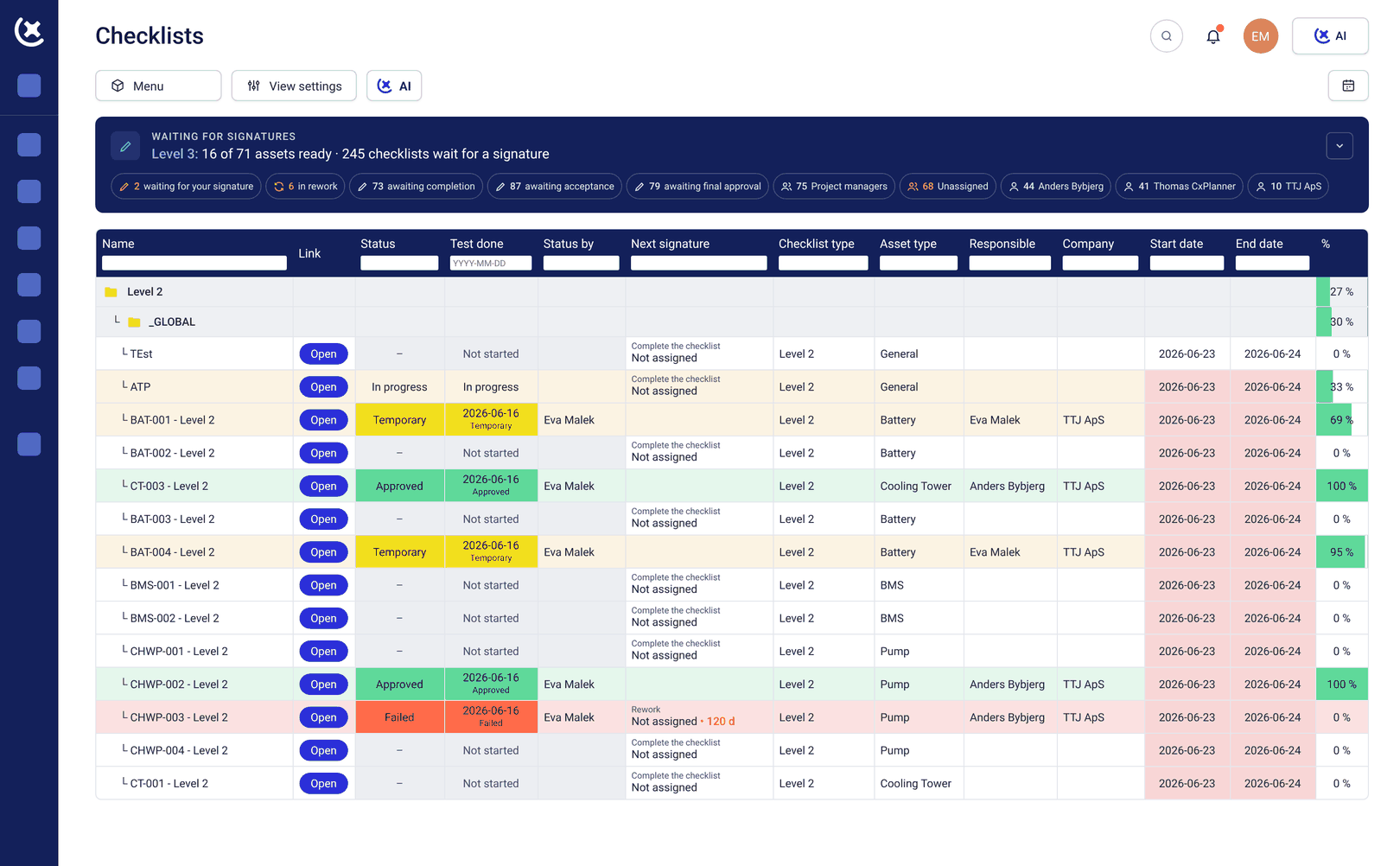
A data center commissioning programme generates a lot of moving parts across five levels. CxPlanner's commissioning software is built to keep all of it - schedules, checklists, asset records and sign-off - in one place instead of scattered across spreadsheets.
Fits any project size
Whether the programme is running a straightforward 5-level structure or an extended 7-level version, CxPlanner scales to the project rather than forcing the project to fit the tool.
Confidence and structure for every stakeholder
A defined workflow per level means owners and clients get clear proof that every level has actually been tested, not just a status update that says so.
One checklist system, not a folder of spreadsheets
Every test and its requirements live in CxPlanner rather than across a dozen files. It's the same platform used across data center projects worldwide, built for commissioning teams who need speed without losing the paper trail.
Want to run your Level 1-5 testing programme inside one platform instead of five spreadsheets? Book a demo and we'll walk through it with your own project setup.
Book a demo with Thomas